Back in 2009, when I was just 9 years old, the first fashion summit took place in Copenhagen. Concerns about climate change and the climate crisis were growing rapidly, partly due to Al Gore’s 2006 documentary “An Inconvenient Truth.” That same year, the COP15—the annual United Nations Climate Change Conference—was scheduled to be held in Copenhagen. However, to the surprise of Eva Kruse, founder of both Copenhagen Fashion Week and the Danish Fashion Institute, fashion was not on the agenda.
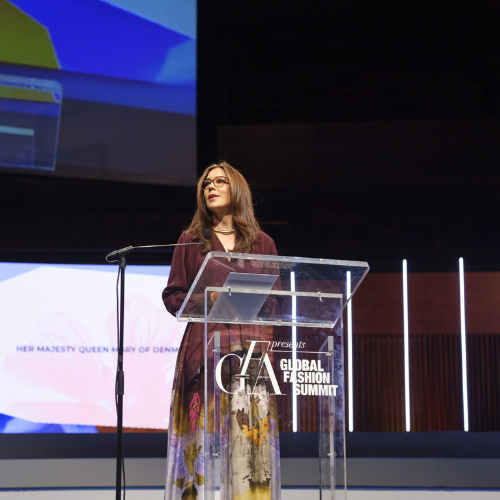
Determined to change this, Eva Kruse and her team organized the first edition of the Global Fashion Summit, creating a platform for the fashion industry to unite and address the pressing issues in the fashion industry. The summit featured speakers from major brands like H&M and Prada, and it was attended by now Queen Mary Elizabeth of Denmark, who has remained a patron of the conference and attended again this year.
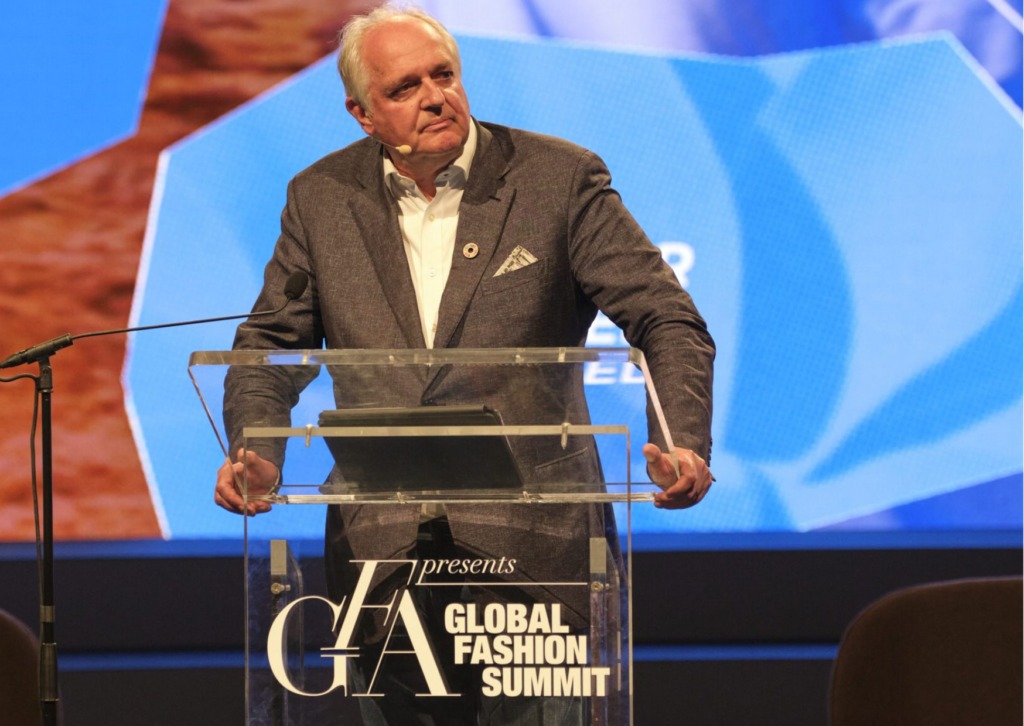
In addition to the Queen, this year several of the biggest names in the fashion industry attended, including Marie-Claire Daveu, Chief Sustainability and Institutional Affairs Officer at Kering; Ganni Founder Nicolaj Reffstrup; Ryan Gellert, CEO of Patagonia Works & Patagonia, and many more.
However, despite being the place where thousands of fashion representatives gather to discuss the future of fashion, the event receives a lot of criticism—and, in my opinion, not without merit.
It’s been 15 years since the first edition, and little has improved in the fashion industry. Yes, many amazing innovations have been developed, and changes have been made, but it is not enough. The fashion industry is still rapidly increasing and is expected to reach a market value of 1.1 trillion US dollars by 2026. Despite the need to halve greenhouse gas emissions to comply with the Paris Agreement, the industry is actually on its way to increase its emissions by 40%.
To many, it seems like the Global Fashion Summit gives the impression that more is being done on the sustainability front than actually is. It often feels like a lot of people coming together and patting themselves on the back instead of doing the work that needs to be done.
Important topics like climate, diversity, ethics, and sustainability have made it to the C-suite’s (CEO, CFO, COO etc.) agendas, but the industry’s effort to tackle these issues remains largely unseen.
As Eva Kruse said during the summit, “Honestly, I am disappointed that we’re not further along. Fifteen years! When we first started, we didn’t think it would go on for so long. I thought we would solve the problem and move on to another topic. It still feels like we’re scratching the surface.”
Eva Kruse, Image Credit Global Fashion Agenda
This year’s theme, “Unlocking the Next Level: 15 Years of Activating Impact,” aptly addresses the urgency of the situation.
With deadlines rapidly approaching—only a few months until 2025—it is crucial for the industry to double down and ramp up its sustainability efforts.
The 2024 Global Fashion Summit served as a powerful reminder to increase our efforts, address societal and environmental impacts, and challenge the current linear business models and existing paradigms.
As Global Fashion Agenda CEO Federica Marchionni stated, “The summit is one tool, but it is not the only one. We will keep on going, pushing and pushing on the same subject until it gets done. Our goal is not to keep the summit; our goal is to transform the industry.”
The summit offered a perfect opportunity for those genuinely committed to making a change to come together and collaborate. The talks and discussions were excellent for learning about various developments in the fashion industry, discovering key figures in the field, and understanding different perspectives. Additionally, the Innovation Forum provided an ideal platform for smaller organizations to gain recognition and showcase their groundbreaking ideas.
The Global Fashion Summit
During the summit, many speakers presented, and amazing talks took place throughout the concert hall. Unfortunately, I couldn’t attend every discussion, but here are three of the major topics that were covered.
The Future of Sustainable Fashion: Circularity for the win
The message is clear. According to the visitors of the Global Fashion Summit, the circular economy is THE way to create a sustainable fashion future.
Currently, our fashion industry operates on a linear model: produce, consume, and dispose. This approach, accelerated by the introduction of AI and innovative technologies, has proven detrimental to the planet. Massive waste is created, with landfills of clothes expanding rapidly. The industry relies on non-renewable resources, contributing to major water and energy consumption, and pollution and microplastics continuously leak into the environment. Additionally, this model is harmful to garment workers, who are forced to work in unhealthy and unsafe conditions while barely earning a living wage.
Hilde van Duijn, Managing Director of Circle Economy Foundation, defines circularity in fashion as “designing out waste, keeping products and materials in continuous use, and regenerating natural systems.”
One expert said, “Circular business models are one of the fastest ways to reduce the environmental impacts of the fashion industry.” Circular fashion cuts waste by making products durable, repairable, and recyclable. It saves natural resources by reusing materials, reduces greenhouse gas emissions, cuts pollution by eliminating harmful substances, and promotes sustainable consumption.
So, if circular business models are so effective, why are only 3.5% of fashion businesses using them? Dr. Achim Berg explains that circular business models seem complex. Businesses need to include recycling and repair, whereas in a linear model, they just make and sell new products without further responsibility. Changing to a circular model would cost a lot, and brands are not willing to spend this money right now.
Despite these challenges, progress is happening. Logistics company Maersk is working with VF Corporation, which owns brands like Vans, on reverse logistics. This means taking products back from customers into the supply chain, extending the life of garments and reducing their environmental impact. Over 60% of clothes bought online are returned, and brands often discard them because it’s cheaper than repairing and reselling. Maersk’s reverse logistics make this process easier and more cost-effective. However, Maersk acknowledges that for this to work, consumers need to take the initiative by returning their clothes.
Reverse Logistics for Circular Fashion Systems, Image Credit: Global Fashion Agenda
Another new project from the summit is “The Fashion ReModel” by the Ellen MacArthur Foundation. It will help companies like Arc’teryx, ARKET, COS, H&M Group, Primark, Reformation, WEEKDAY, and Zalando move to a circular economy. This includes redesigning products to be more circular and offering rental, repair, and resale services. It’s an exciting initiative, and it will be interesting to see how it develops.
However, one thing is clear: despite good initiatives, technologies, and innovations, scaling them up is necessary to make a real impact. This is difficult for companies due to a lack of understanding and, more importantly, a lack of money.
Where is the Money?
The fashion industry is at a crossroad. To help the environment and create a sustainable future, a lot of money is needed. However, getting this money is very difficult. The world is currently facing a period of economic volatility driven by rising political tensions and a downturn. Although the climate crisis is arguably a major contributor to these issues, it is not given as much attention by companies as other urgent issues.
The lack of funding for sustainable fashion is clear. For example, the recent bankruptcy of textile-to-textile recycler Re:NewCell, shows how hard it is to make progress without enough financial support.
Circulose by Re:NewCell
The fashion industry’s supply chain is highly fragmented and complex, making it hard to decide who should pay for the sustainability projects. Fashion brands have significant power and profits, but much of the environmental damage happens further down the supply chain, in areas like dyeing and material sourcing, which are often outside their direct control. This complexity leads to a lack of responsibility, making it harder to invest in sustainable practices.
Long-term investments in sustainability are seen as risky in the unpredictable fashion industry. As Thomas Tochtermann, chairperson of the Global Fashion Agenda, points out, manufacturers take a big risk when investing in renewable energy or sustainable practices because fashion brands might only work with them for a short time. This risk discourages both brands and investors from committing to long-term sustainability projects.
In addition, the complex nature of the fashion industry makes it hard for investors to see the full picture and assess the potential returns on their investments.
But as one speaker highlighted, “the cost of not acting, is going to hurt profits, and the climate crisis is making us lose money.” So, unless fashion brands invest in sustainability initiatives, they will lose money anyway.
But, despite these challenges, there are positive signs of progress. For instance, H&M Group’s polyester recycling company, Syre, along with green investor Vargas, raised $100 million to complete a pilot plant. Bestseller also pledged $100 million to an offshore wind park near Bangladesh.
These are amazing examples of how investments in sustainability are possible.
No Change Without Politics
The lack of progress in the fashion industry has not gone unnoticed. Regulators and governments are stepping in to take action where fashion brands—and, to be completely honest, consumers—have failed. Several governments are working on laws to force change.
We have already seen some of this in action, especially in Europe. France, for instance, introduced a new law to ban advertisements from ultra-fast fashion brands like Shein. It also requires these brands to raise their prices to make them less tempting for buyers.
Other laws in the European Union, like the new anti-greenwashing law, the Corporate Sustainability Reporting Directive, and the Corporate Sustainability Due Diligence Directive, will also affect the fashion industry.
Moreover, last week several fashion brands, including Calvin Klein and H&M Group signed binding agreements to support higher wages in Cambodja.
In the US, action at the state level is also expected soon, particularly after next year’s elections.
These new regulations will mean that taking action will be mandatory instead of the current voluntary practices.
As Paul Polman, author of Net Positive, said about regulations, “Don’t view them as a handcuff or restricting business; see them as a mechanism to drive the fashion industry to new heights, to move the floor up faster, and to eliminate the free riders.”